


By Cynthia Winward
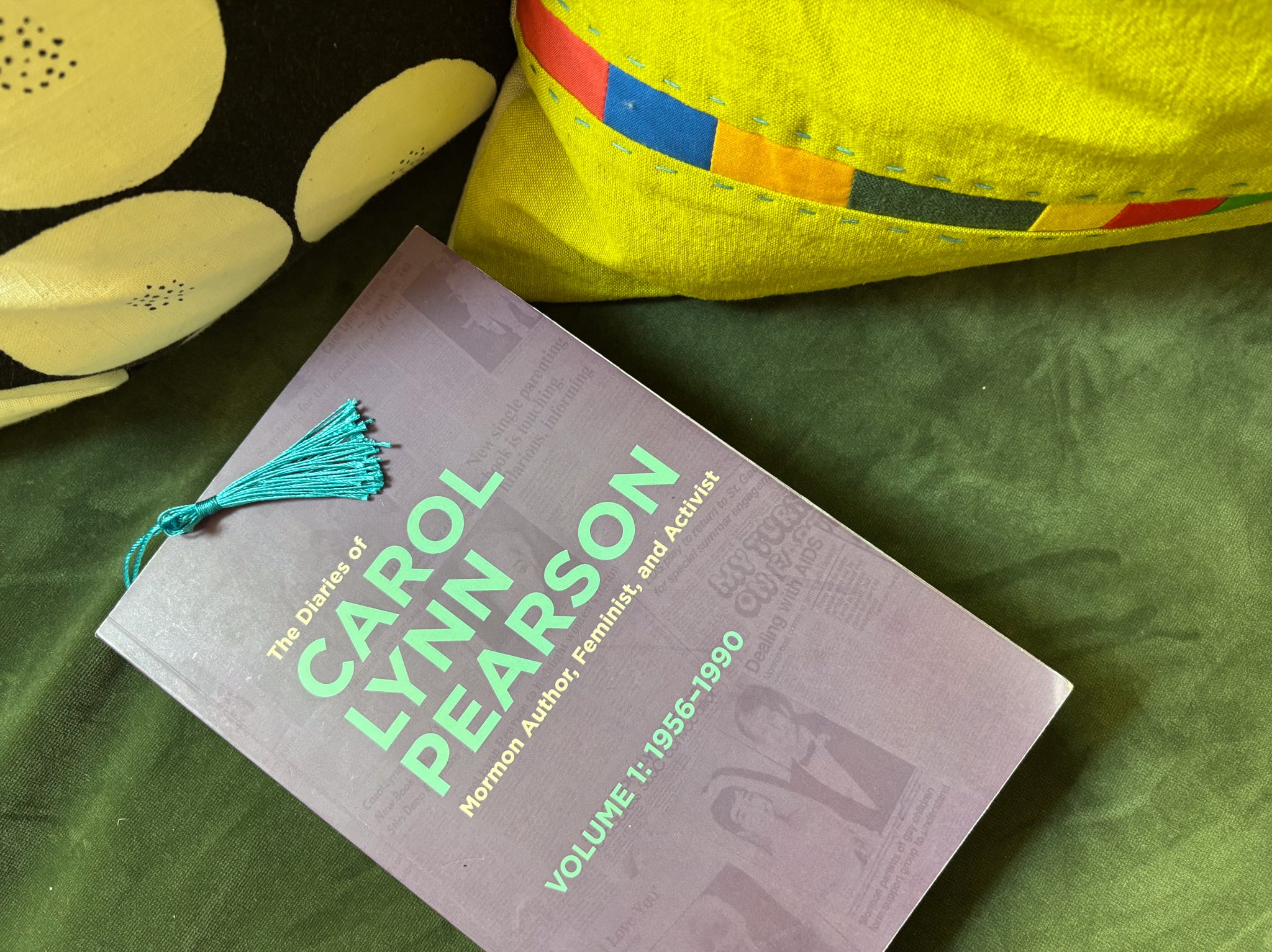
“I find that just about everywhere I go, if you scratch a Mormon woman, you can find something of a feminist, whether she would ever call herself that or not.”
- CLP, May 7, 1986
For weeks I’ve been knee-deep
in Volume 1 of the Carol Lynn Pearson diaries. Then when I heard that she had passed on July 29, 2026 it felt particularly heavy—as if I had just lost a friend. Daily I have been texting Susan or another friend messages such as, “Today’s reading from CLP that has me melting down is….”
At this point in my Mormony-ness I didn’t think much could trigger my melt-down-meter. After all, I’ve read all the popular Church history books,1 so much so that recently I texted Susan and said, “I think I am completely done reading about messy Mormon history,” which is 95% about men in unmerited positions of authority. But the women? I am always open to learning more about my fellow sisterly saints.
Enter the diaries of Carol Lynn Pearson (CLP), who, as a woman, has heard the private voices and unfiltered opinions of regular women—as well as the women in leadership roles—since the 1960s. And when women talk privately they do not hold back with Carol Lynn!
Up until now, the biggest view behind the curtain of LDS women in leadership we’d had is when Chieko Okazaki gave that now-infamous Dialogue Interview, as well as in 2021 when the Church announced that in Europe women had been called as Area Organization Advisors for the Relief Society and Young Women organizations. About that, I wrote in our book chapter called ‘For the Men in the Room,’2
What fascinated me was reading the press release from the church announcing the change, and highlighting what our general women leaders had to say about this change. Linda Burton, the Relief Society General President from 2012 to 2017, said: “It is the link that has been missing.” Bonnie Cordon, Young Women General President at the time, said: “It truly feels like the missing piece of the puzzle.” What’s difficult about their reactions is that we never would have heard these women utter these statements—that it felt like something was missing—prior to this change. How long had they thought something was missing? Years? Decades?”
The above example is fairly benign, it’s more a statement that something was missing rather than their personal feelings about the patriarchy. But in the CLP diaries we get a behind-the-scenes look at the pain points of women in leadership. Here are six diary entries documenting such conversations:
October 23, 1972—In this diary entry CLP is talking to Amy Valentine, a General Board member of the Relief Society. Carol Lynn asked her if Belle Spafford, general Relief Society president at the time, supported the brethren, particularly about correlation - “I can say without hesitation that sometimes she [Spafford] gets pretty hot under the collar. I felt so bad when funds were taken out of our hands recently; all the Relief Society presidents have to go to the bishop whenever they need anything. I felt it was a real step down.”
March 10, 1987—Belva Ashton, General Board member of the Relief Society when correlation3 happened: “I’ll tell you what, Carol Lynn, I think we’ve hit the bottom and the only way now is up…Belva remembers Belle Spafford saying to the Board when she saw the damage: ‘They closed us down. They’ve closed down the Relief Society.’ And when Barbara Smith took over she had not much power. The budget was taken out of the hands of the R.S., they could not call their own counselors, could not have control over their own lessons, lost the Relief Society magazine, etc.”
Apparently a lot of the Board members convinced their president, Barbara Smith, to write a letter to the brethren asking them to make some concessions after correlation. “Barbara was called in (by one of the Seventies whose name she would not give me) and he ‘tore her apart’. He told her never, never to do anything like that again. Barbara went back to her office and locked the door and sobbed and sobbed. She didn’t go home. Her husband called that evening and she didn’t answer the phone. Finally he went to her office and found her just devastated.”
August 15, 1977—“Aileen Clyde [RS General Board member and later RS counselor to Elaine Jack] took a deep breath and dived in. ‘I have felt all along on this committee that I was not being entirely open. In my heart I am for the ERA and I do not see all of the terrible things coming that the opponents predict if it is passed.’ Sister [Barbara] Smith, [RS Pres. from 74-84] would you be willing to tell us the real reason why the Church is against it? There must be some reason.
Barbara Smith’s response was: ‘I believe the Brethren feel it would weaken the position of the priesthood.’ So she will admit this at last, if only to herself and a few trusted others. This has been absolutely obvious to me all along: the fear of attack upon male authority.”
February 21, 1986—Emma Lou Thayne, who served on the Young Women’s General Board, author of the beloved hymn, Where Can I Turn For Peace (along with Susan’s own mother!) and was the “token woman“ (Emma Lou’s words, according to CLP) on the Deseret News board. The Deseret News had been working on a series for months about homosexuality in the church. Emma Lou was really discouraged to learn that it was abruptly cut off because the First Presidency got word of it. Emma Lou said to CLP, “I feel like I’m just a little barking dog. I go yip yip yip and they pat me on the head and say that’s all right.” Emma Lou Thayne said when these kinds of things happen [censorship of articles] and they happen often she says to herself “Who needs the church? Why are we even doing this!”
March 11, 1986—“Aileen Clyde called me the other day and said ‘things are worse for women in the Church now than they’ve ever been at any time in the history of the Church.”
January 16, 1972—“Just now I was speaking to Dorothy Rea on the phone [Deseret News reporter, columnist and photographer] A lot of people are worried, she feels, that the ERA has an implication for the priesthood in the Church. (I guess I mean against the Church.) She spoke quite frankly, saying among other things: ‘I’m glad you’re as young as you are, Carol Lynn. I’m just too old to fight Mormondom anymore. I know that the Lord does not discriminate against women, but some of these self-made Church men certainly do. The priesthood is the only ‘power’ some men will ever have, and they grind it right into the ground.”
Now do you understand why I have been melting down? And not just because July 2026 was the third hottest July on record in Utah history! 🥵 I don’t know why I assumed women in leadership were called by The Men in Charge because they preferred the status quo of women in the Church. But if I only have their public statements to go by, it’s no wonder I thought they loved patriarchy! Their private sentiments, though, give me another picture of them, least of which is that LDS women are complicated. (Duh!) Nobody’s public comments always match her private comments. But truly I was surprised at their level of disappointment. What didn’t come as a shock to me though is that LDS women in leadership—then and now—still don’t publicly voice their concerns about our place in the church.
In 2019 I thought LDS women leaders were getting close to open dialogue about equality when BYU Women’s conference4 held a panel with our top women church leaders and one of the topics addressed was how to deal with dismissive male church leaders. Here we go, ladies, say it, at last! Jean Bingham, then president of the Relief Society, did have the courage to admit she’d had interactions with a dismissive leader that left her “seething.” She called her interactions with him “purse slamming” moments. Lest I thought she was going to then talk about unrighteous dominion or the power imbalance that exists between men and women, nope, she made excuses saying that she learned over time how to work with him. That it was a “style and personality issue.” That as she prayed for him she learned better ways to approach him.
She went on to say that recently she had counseled with a ward RS president going through the same problem with a dismissive male leader and she gave her that same counsel—to pray for better ways to work with him. In other words, the woman needed to do all the changing. The problem couldn’t possibly be the power imbalance between men and women in the church. Or the “asymmetry,” as Dale Renlund calls the power imbalance.5

“Making yourself smaller is what gave you a seat at the table.”
—Sara Fisk6
But what happened next might be my number one most disappointing thing an LDS woman has ever said on the record. Bingham blamed herself— “We women tend to be shrill or demanding or stubborn, thinking we have the best idea ever.” Nooooooo! Shrill? Really? Men in charge can act badly but the real problem is shrill women? Bingham closed her comments with a type of postscript: “One of the things my parents taught me when we have a challenge with a leader is we do not criticize, ever, ever, ever. I never heard my parents say one negative thing, because it doesn’t help.”7 Hmmmm, sound familiar? This is the same advice given to Barbara Smith in the 1970s—never ever critique. Has nothing changed between 1977 and 2019?
I think it is highly problematic in a hierarchical power structure like the LDS Church—one in which men are always on the top of the org chart and women are always on the bottom—to tell the person who lacks power to look at herself first and say, like Bingham counseled the struggling women, to look within and to ask, ‘Lord, Is it I?” and then to follow that up with advice to never criticize. This is how systems of oppression and domination continue. We teach the group with lesser power to never see those in power as having any fault. Look within and never speak it out loud. Ever, ever, ever.
Thank goodness the internet has allowed for the democratization of LDS women’s voices. Regular women like me, and Susan—and all of you—have public ways to voice our private concerns. I don’t know if the women in the CLP diaries would’ve done anything differently had they lived today. Would they have started a blog? Been a guest on a podcast? Privately joined a chat room with a name like ‘PurseSlammingProvoMom’?
Reading volume 1 of The Diaries of Carol Lynn Pearson while sweating through July offered me a gift that our manuals and church magazines never have and probably never will. My leaders were not—and are not—the passive cheerleaders of patriarchy that their public statements forced them to be. They were sharp women, deeply frustrated, and acutely aware of the “asymmetry” crushing them. So I’ll pick up my melty self off the floor, satisfied today to know that my foremothers have seen every inequity that I see as well. It changes nothing in the organization, but it changes everything in me.
“It is better that one woman should perish than that the whole church should dwindle and perish in equality.”
- CLP, January 22, 1980
*this was a diary entry written after Sonia Johnson was excommunicated*

Cynthia Winward

A small list of Church history books I’ve read: Kingdom of Nauvoo, American Zion, Rough Stone Rolling, David O. McKay and the Rise of Modern Mormonism, Gay Rights and The Mormon Church, Second-Class Saints, Brigham Young: Pioneer Prophet, A House Full of Females.
We also talked about this very topic—about women being shrill—on our “How to Be A Smart Mouth” Episode 93
In The Church of Jesus Christ of Latter-day Saints, correlation is the administrative and doctrinal process used to unify, simplify, and bring all church programs, curricula, publications, and organizations under the centralized direction of the priesthood leadership.
Peggy Fletcher Stack, “Latter-day Saint women’s leader discusses how to deal with dismissive male authorities,” Salt Lake Tribune, May 3, 2019, https://www.sltrib.com/religion/2019/05/03/latter-day-saint-womens/
In Arcadia, California apostle Dale Renlund said, “The reason for the asymmetry between men and women regarding priesthood office ordination has not been revealed.”
Sara Bybee Fisk quote, “Why Speaking Up Feels So Hard for Women,” on Breaking Down Patriarchy
Sister to Sister Event, To see the question about dismissive leaders and all their responses, go to approximately minute 15
Isn’t this a great space? We hope you’ll share ALSSI with anyone you think might benefit from our community. More voices, please!
Every woman should read this and then read it again. In my memoir 'Confessions of a Once Upon a Time Mormon Girl" I talk about the lies women tell just to keep themselves in the good graces of the church, and they do this because men hold all the power, especially the power to excommunicate a woman for ANY reason. A Mormon woman learns that she can never tell the truth.
Oh gosh, this is so bittersweet. I love that our women leaders were thinking these things all along, that they saw the cruel inequality, but the fact that they had to silence or soften themselves in order to maintain what little power they had in the church is so hard to stomach. I sat thru many stake and ward meetings just burning inside, knowing something felt wrong, but having no words or voice to speak. I pushed aside that “Holy Ghost” that urged me to speak out, the one I was born with and replaced it with an imposter provided by men that encouraged silent compliance and I regret that. ☹️