


Eager to Hope
by Susan Hinckley
Last weekend I participated in our local protest,
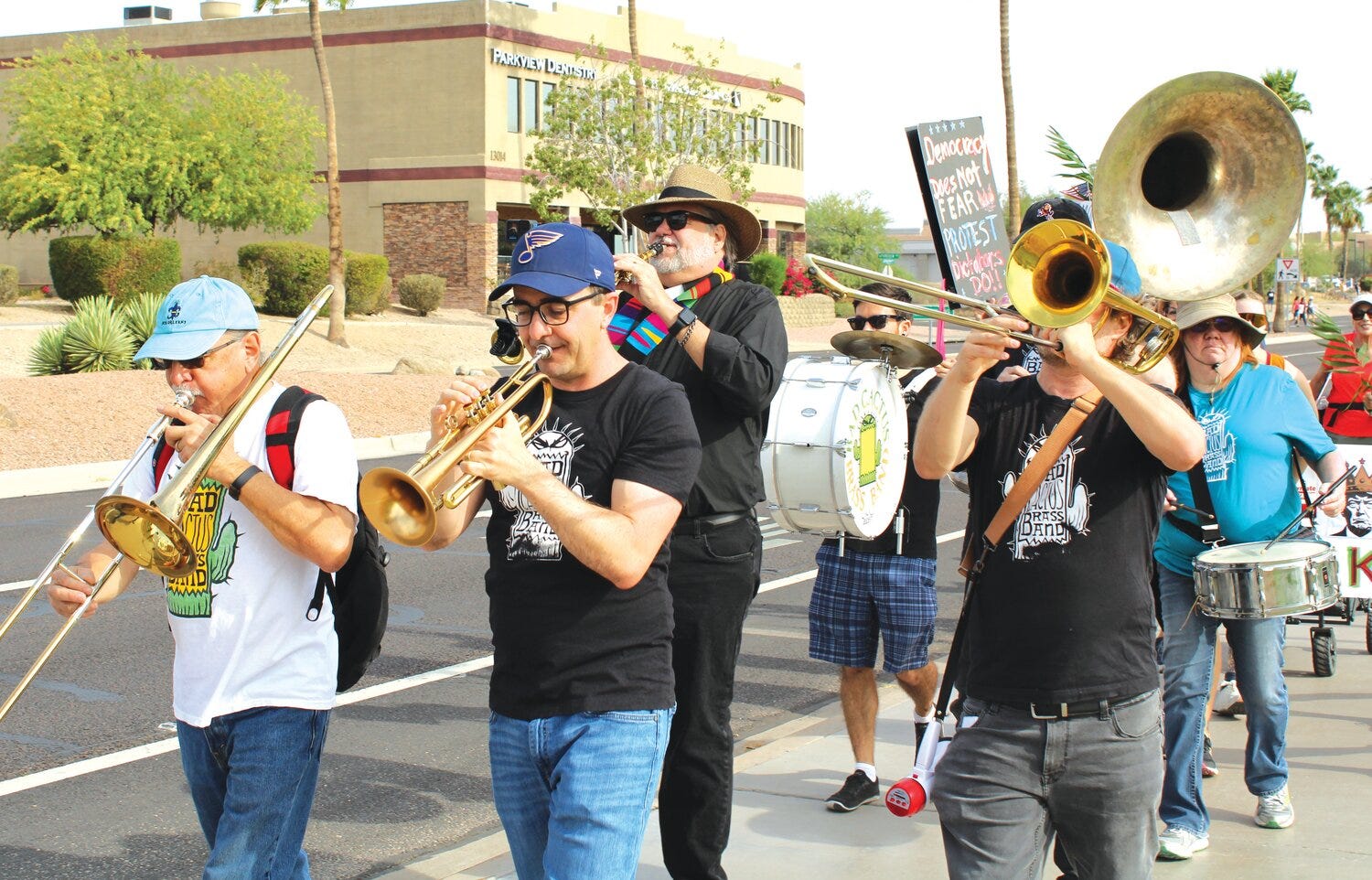
because I think protests are public hope and I needed to both give and receive. Despite this being the reddest of small towns, there were hundreds of us—5x as many people as I expected. The crowd was anchored by a few full-size US flags, confidently riding the morning wind. Those flags understood the assignment; something in me quickened as I parked. A small marching band trumpeted hope up and down the sidewalk.
Environmentalist Bill McKibben was once asked, "What's the best thing I can do as an individual?" He said, "Stop being an individual.”1 I showed up needing to feel less alone, and got all the right medicine. Most of the passing drivers honked, waved, and gave us a thumbs-up.
Of course there were a few whose sneers and gestures made clear their contempt. As I stood fighting to keep my poster upright in the wind, a red car approached and slowed to a stop in front of me. The window slid down. A woman leaned out, looked right at me and said, “You know, he is YOUR president. He is the president of every single one of you.” She drove away.
As if that should end the protest. As if anyone could so smugly close the lid on hope.
I haven’t stopped thinking about the woman in the red car, and about all the things I didn’t say in response.
There are a few lessons I’ve always thought God made particularly obvious. Diversity is one—look around—and creativity is another. A third I see writ large in the natural world is hope. Morning was the first advertisement for this concept, but because it comes every day we tend to stop noticing. Maybe God knew we’d have a hard time paying attention to a thing that happened so often. Maybe that’s why they also came up with spring.
Of course God put winter first to really get our attention—to bring us right to the edge of giving up—before adding spring to the calendar. In ink. Not often enough that we’d quit noticing either, surprised by joy every time a weeping cherry drapes itself sky-to-ground in pink ribbons.
The thing about spring is, it always comes. It doesn’t matter how hard the winter is, or how evil the king. It doesn’t matter if there’s a huge snowstorm in April that pushes us to the brink of really not being okay. Spring prevails every time.
American theologian Walter Brueggemann said, “Hope arises from memory.”
Rebecca Solnit explains, “You can turn that inside out to say that despair arises from forgetting. If you forget that every good thing we have came about as the result of a heroic struggle, of course you will despair.” She says that optimism and pessimism “assume we know the future, and therefore nothing is required from us. I think the future is radically uncertain, and therefore much is required of us.”2
But is hope too much to expect in the face of radical uncertainty?
Well, what else is there? Gripping everything tighter isn’t going to give us any guarantees, but engaging with hope means we’re showing up for the future no matter what heroic struggle it brings, because there is no way to get where we want to go next except through whatever is happening now.
I remember exactly where I was sitting in an AP English classroom about 100 years ago when the teacher ridiculed a student for using the word anxious when they actually meant eager, and I realized for the first time with a spark that those words aren’t interchangeable. No matter how often they get swapped in casual speech, eager is about positive anticipation and anxious is about worry. As that came into focus for me, the very next second I thought, “Pretty sure Joseph Smith made a mistake.” In D&C 58, being “anxiously engaged in a good cause” was surely meant to be about eagerness to do good. I don’t think he meant to suggest we should feel nervous about the uncertainty of our actions or outcomes while we engage in that goodness.
But I’ve been anxiously engaged my whole life as a Latter-day Saint. I took the words to heart just the way Joseph wrote them.
I’m not sure exactly how this worked, but all that anxious engagement over many decades seems to have resulted in some serious hope muscle. As I enter my later years, I find my core is all made of hope. Maybe it came from so many years showing up and doing all the church things while thinking, “I’m really not very good at this. I’m not sure I’m doing it right. I have no idea whether it will be enough.” Maybe when you feel a little doomed from the start, but you press on anyway, you get in the habit of grasping anything you can find that might make up the difference. You hope.
And I don’t mean feeling hopeful. I don’t mean a grin that comes back no matter how often reality turns its power-washer on you. I mean hope as a verb. As a thing you decide to do. As a perspective you have, because you bring it. Hope is not something that arises spontaneously and promises to work everything out. Anxious or eager, the work is the same. But I’ve come to prefer eager: Hope is a way I can choose to engage.
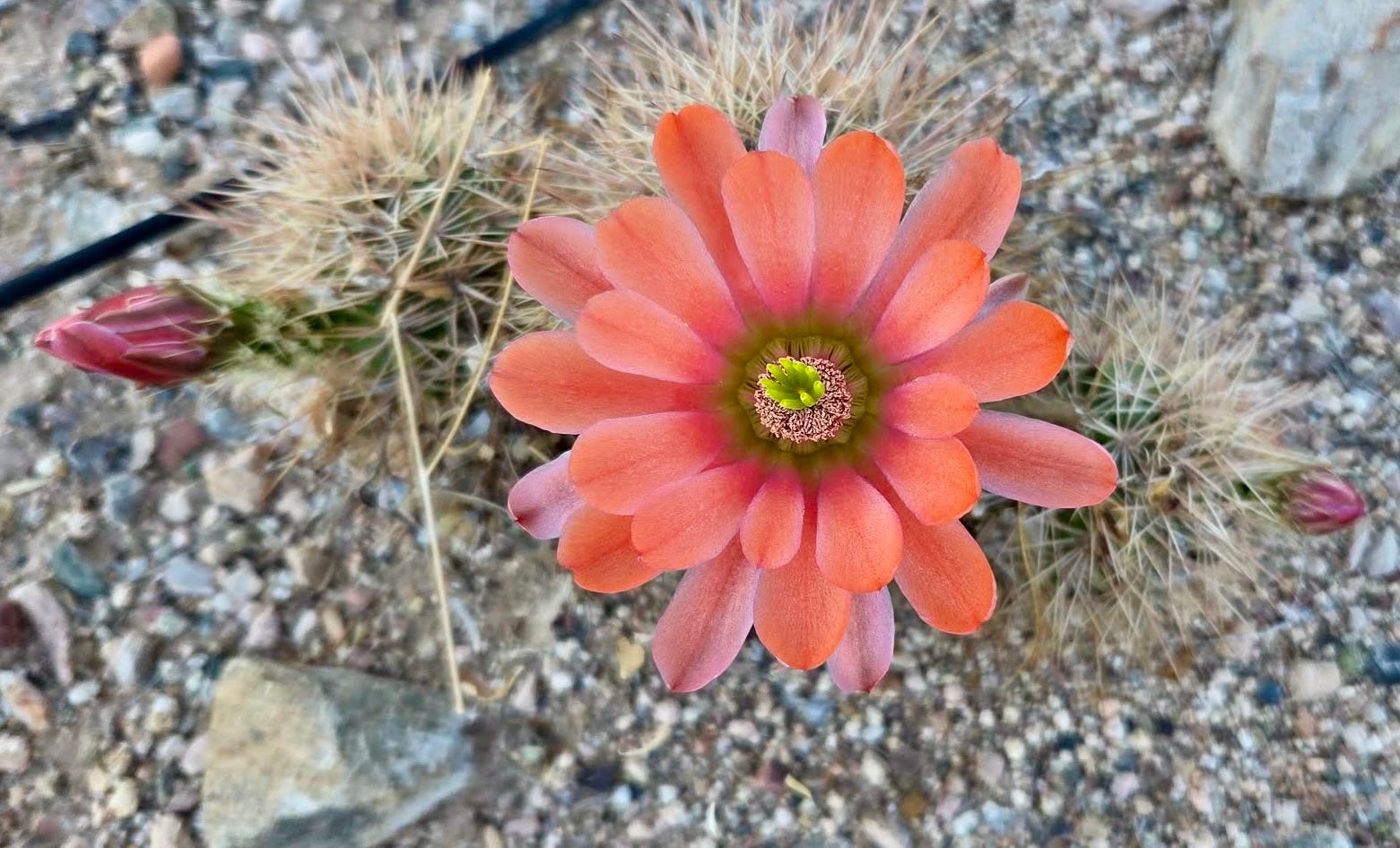
I wish I’d known I didn’t need to feel so worried all those years. I wish I could go back and tell my young self, “See those flowers? They probably aren’t worried at all—yes, winter knocks ‘em out, in fact, it straight-up kills some. But there’s always spring, and flowers don’t have to earn it—all they have to do is wait for it.”
“Consider the lilies,” Jesus said. “They seem to remember something you don’t.”
Flipping from anxious to eager in my spiritual life has mostly been a function of embracing my own hope. “God is always present in reality as it is. Not as it should be,” says Richard Rohr.3 I think this is one of the reasons Jesus showed up on earth, getting everyone’s hopes up, but then surprised even the people closest to him by becoming victorious only after an unimaginable defeat. It was a lesson so bewildering, even people who desperately wanted the miracle had a hard time accepting the truth of what they were seeing in real time. How could something so awful be the doorway to lasting hope?
Thomas had his doubts; unfortunately he’s remembered for them. But do you know what he did next? He took Christianity to India and beyond, converting many to the very idea he had such a hard time getting his head around. He may have needed to touch for himself, but that experience powered a lifetime of ministry. It’s fair to say reality transmuted the moment of doubt into something truly sustaining.
The practice of hope must be a principle through which God thought humans could remind ourselves of divine love no matter what else is going on.
But God’s love was in the world before Jesus ever got here. “It is good, in fact, it is very good,” God says, the punchline of the whole opening monologue. A few minutes later, we find out “good” may be more complicated than we thought—no one was going to be allowed to stick around, basking in the very-good-ness of a garden. I think everything God says and does after that is trying to teach us about hope—even in the face of the bleakest reality—and I can see why the best object lesson to do that would probably be our own screw ups.
“We’ve met the enemy, and he is us,” says the famous Walt Kelly comic strip.4 The practice of hope must be a principle through which God thought humans could remind ourselves of divine love no matter what else is going on.
I’ve decided another idea articulated by Richard Rohr could be repurposed into a good definition of hope: “the ability to flourish inside of paradox.” We know what has happened, and we know what’s happening now, but I don’t think we can be at all certain what it means in real time, and we never know what’s going to happen next, even when we think we do. We can be sure it will be bad and good and then bad again and then sometimes better, but there’s no guarantee. A yes for every no, and a no for each yes. Life will be loss and abundance, joy and sorrow tossed together. “Reality’s conjunction is always and,” writes Christian Wiman.5
That’s where I think hope lives. Hope is in the and.
So what do we do when we’re really not feeling it? Hope, faith, and love show up together in the Bible. Sharon Salzberg teaches6 that the word translated there as faith is actually a verb—it’s not a thing we have so much as a thing we do. Hope and love already operate as verbs in modern English; moving faith into the verb column makes sense, if these foundational principles walk hand in hand. A quote from Rabbi Abraham Heschel says, “Faith is mostly faithfulness to the times when we had faith.”7 I understand this as, “Faith is a thing we keep doing because we once felt it.”
Anyone who’s been in a long term relationship knows love operates the same way. We fall in love with someone, then we keep loving them on the days it’s hard to do so, because love is no longer a feeling so much as an action.
The emotion of hope is also less useful than the action. When hope-the-noun becomes hope-the-verb, we go to the protest whether or not we think it will change anything. We’re eagerly engaged, smack in the middle of not knowing. We follow hope instinctively because it’s all there is to do in the face of such radical uncertainty. It’s the thing we can control.
The woman in the red car—and everyone else who flipped us off that day—thought she could impact my hope by insisting the situation was hopeless. She (and all the efforts I’ve seen since to minimize that hopeful act or dismiss it outright) is missing the point of hope. The only thing hope insists is that, eventually, things will change. That’s based in reality—a measure of calm certainty can reside in the uneasiness of it. Hope-seeds arrive buried in the same dirt we’re standing in. It’s because reality is often objectionable that I choose to orient myself this way. I engage eagerly because of what it does for me today, not because I think it will ensure any future outcome. Hope—and faith and love—don’t operate in the future. They’re how we survive the now.
Trying to stomp out a protest by throwing reality on it is a bit like telling me it’s winter, and I may as well accept that as final. But I spent many years living in the upper Midwest. I know a thing or two about winter. And I know a lot about hope.

Susan Hinckley

‘A New World is Being Born’: author Rebecca Solnit on the slow revolution the far right can not tolerate, by Zoe Williams, The Guardian, 3/25/2026
A New World is Being Born, see above
A Bright Sadness with Christian Wiman, Everything Belongs podcast, Center for Action and Contemplation, 5/8/2024
The Morphology of a Humorous Phrase, Humor in America, 5/19/2014
My Bright Abyss: Meditation of a Modern Believer, by Christian Wiman
Faith: Trusting Your Own Deepest Experience, by Sharon Salzberg
A Bright Sadness with Christian Wiman, see above
I think this is the best thing you’ve written ever (apologies to your dad for the superlative)! It’s so hopeful! Thank you so much for cracking my crusty winter ice covering and exposing the budding bulbs of hope and faith that were lying dormant underneath. ♥️
I needed to read this so much right now. I have felt my hope get smaller and dimmer over the months as I felt powerless in the face of all the political strife. As I also jumped in to protest, send letters, make calls and do what I could, I started to feel better every day. Reading words like these build my hope stronger. Thank you!