


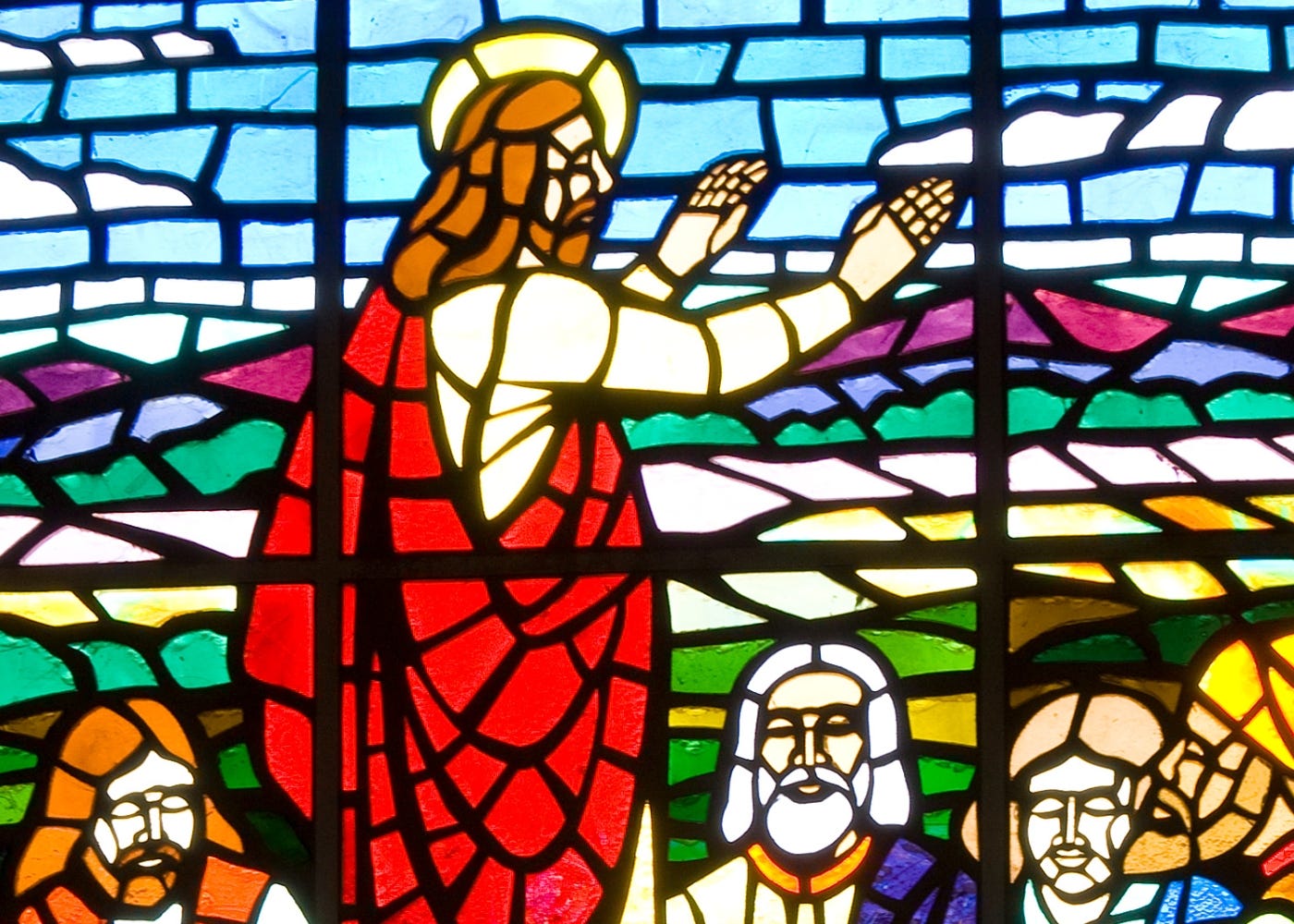
Is there a richer text for Christians than the Beatitudes? Yet we don’t all think or teach about them the same way. Many Latter-day Saints talk and teach about them as a list of saint-like attributes to which we should aspire, traits that will bring us closer to God and eventual exaltation. But Nadia Bolz-Weber suggests, “What if the Beatitudes aren’t about a list of conditions we should try to meet to be blessed? What if they are not virtues we should aspire to? What if Jesus saying ‘blessed are the meek’ is not instructive but performative—that the pronouncement of blessing is actually what confers the blessing itself?’” In Episode 257, Cynthia and Susan ‘dance with the scriptures’ in an attempt to discover new ways of seeing and engaging with these familiar verses.
Notes & Quotes:
Jesus’ Alternative Plan: The Sermon on the Mount, by Richard Rohr
ALSSI Ep. 60, Ep. 106, Ep. 193: What About Blessings? Parts 1, 2, & 3
At Last She Said It: Honest Conversations About Faith, Church, and Everything In Between, by Susan Hinckley and Cynthia Winward
Blessed Are the Poor In Spirit, by Rob Bell
Accidental Saints: Finding God in All the Wrong People, by Nadia Bolz-Weber
Always a Guest: Speaking of Faith Far From Home, by Barbara Brown Taylor
How Do We Interpret the Beatitudes?, by Julius-Kei Kato, The Bart Ehrman Blog, 6/04/2020
Gospel Medicine, by Barbara Brown Taylor
Q & R: Can You Explain the Beatitudes, by Brian McLaren, 11/25/2025
Feeling called to an LDS stronghold, Utah couple deliver grub and the gospel to the hungry, by Mark Eddington, The Salt Lake Tribune, 2/06/2026
Living the Sermon on the Mount: What Does It Mean to be Blessed?, Center for Action and Contemplation, 11/04/2025
On the Beatitudes—Sermon, Contemplative Pastor, 2/01/2011
Simplicity: The Freedom of Letting Go, by Richard Rohr
The Beatitudes and Our Perfection, by Elder Royden G. Derrick, 04/1977
Matthew 5: The Beatitudes, Church website video
“But if to be ‘blessed’ means to be ‘made holy,’ that’s entirely different from popular usage talking about things like good fortune, a desired outcome, or comfort. That simple little definition opened a crack of light for me into this whole complicated conversation. I could suddenly see that a blessing is not an event, nor something we receive in exchange for what we do. It’s independent of external circumstance, because blessing is an internal state.” —Susan Hinckley, p. 102
“The gospel is the announcement that in your pathetic, bedraggled, confused, morally ambiguous state in which there’s nothing good within you, God announces, ‘I’m on your side.’” —Rob Bell
“It can be easy to view the Beatitudes — the “blessed ares”... as Jesus’s command for us to try real hard to be meeker, poorer, and mourn-ier in order that we might be blessed in the eyes of God….Plus, it can be easy to look at, say, Mother Teresa and think, Well, she is a saint because she was meek. So if I, too, want to be blessed, I should try to be meek like her. (Don’t get me wrong, we could use a few more people trying to be like Mother Teresa. I just don’t think that her virtue of meekness is what made her considered blessed by Jesus.) But what if the Beatitudes aren’t about a list of conditions we should try to meet to be blessed? What if they are not virtues we should aspire to? What if Jesus saying “blessed are the meek” is not instructive but performative — that the pronouncement of blessing is actually what confers the blessing itself ?” —Nadia Bolz-Weber, pp. 183-4
“Stopping to remember just how many people are beloved of God: those we suspected and those we did not; those we can name and those we cannot; those who left their marks on this world and those who vanished without a trace…
“They don’t ask for much: spiritual poverty, mournfulness, meekness, mercy-mindedness, single-heartedness, unwillingness to fight, willingness to get beat up. [...] If you were to take a tour of the places where such blessed people have traditionally been found, you would visit a lot of jails, funeral homes, courthouses, cheap restaurants, and emergency rooms, as well as some nice homes in the suburbs and a palace or two. It’s a mixed crowd we belong to—” —Barbara Brown Taylor, Always a Guest, p. 234 (Kindle)
“The historical Jesus as well as the original audience to whom the Beatitudes were directed, were hoping for an imminent world-changing intervention of God (also known as ‘the coming of God’s reign’) into their historical world. That would then create a new world order where, the (really) poor, the (literally) hungry, the weeping ones would be the beneficiaries of this reversal of fortunes brought about by divine action and will be truly (and not only spiritually) ‘blessed,’ thus, truly worthy of being ‘congratulated.’” —Julius-Kei Kato
“If the only way to get to the 2nd half of the sentence is to go through the first, then who in their right mind wants to go? [...] Jesus is not telling anyone what to do. He is telling us how things really are. [...] Everything that follows is going to be based on the tipsy worldview of the Beatitudes. Love your enemies, do good to those who hate you. Bless those who curse you, pray for those who abuse you.” —Barbara Brown Taylor
“The moment we look down on somebody because they aren’t disciplined, hardworking, upright, smart, responsible, moral, good looking, Bible believing, Jesus trusting, or as God fearing as we are because they’ve made idiotic, stupid, immoral choices again and again and again, at that moment we are rich in spirit and Jesus isn’t announcing anything to us.” —Rob Bell
“What was so shocking about Jesus’ list was not the form but the content. Blessed are the meek? The mournful? The poor in spirit? Who was he kidding? …. What was so happy about hungering and thirsting for righteousness, or about being reviled and persecuted?....No one with a lick of sense was going to vote for any of those definitions of the Good Life, but Jesus did not ask for anyone’s approval. He just redefined the Good Life in nine short sentences and held them out for everyone to see: nine portraits of kingdom people, previously known as victims, dreamers, pushovers, and fools.” —Barbara Brown Taylor, Gospel Medicine, p. 160
“Here, I think, is the key to the beatitudes. Rather than interpreting them as ‘God blesses these people’ – Think: this is performative, like performing a wedding and saying, ‘I now pronounce you legally married,’ or ‘We pledge allegiance …’ The saying of the words performs the action. To bless is to speak highly of, to praise the goodness and value of. The point is … WE bless these people, here and now. We say they have worth and value. We say their lives matter. We say they count. We say they are important.” —Brian McLaren
“In the wake of the original apocalyptic context of the Beatitudes being unrealized, they should now be theologically interpreted through the lens of a realized, collaborative, incarnational eschatology by which the promised rewards of the Beatitudes no longer depend on an apocalyptic intervention of God but on the followers of Jesus (or practically anyone else [even agnostics/atheists] who think that Jesus was a great teacher) taking on a liberative praxis to create in some way and realize a new social order where the really poor, the truly hungry, the weeping and marginalized ones really come to experience now (not later in some heaven) some measure of the blessedness that God’s reign should bring with it.” —Julius-Kei Kato
“The first words out of Jesus’ mouth are not “Blessed shall be” but “Blessed are.” “Blessed are the poor in spirit”—not because of something that will happen to them later but because of what their poverty opens up in them right now. “Blessed are those who hunger and thirst for righteousness”—not because God is going to fill them up later but because their appetites are so fine-tuned right now….” —Barbara Brown Taylor, Always a Guest, p. 202
“Notice how [Jesus] also uses present tense: ... the Reign of God isn’t later. It’s present tense: We are the free ones now, if we remain without anything to protect or anything we need to prove or defend. I know people who have left Christianity to become Buddhists precisely because of the doctrines of emptiness, simplicity, and nonviolence that they discovered in Buddhist teaching. If only they had been taught these same foundations in Jesus’ Beatitudes!” —Richard Rohr, Jesus’ Alternative Plan, p. 160
“It has been two thousands years and the poor are still with us. Those who hunger for justice are still hungry. The mournful are still blowing their noses, and the excluded are still waiting at the border. The Beatitudes may work for people who can wait until they die for their reward, but meanwhile there are other people who have lost faith in Jesus’ promises. They aren’t feeling the joy. They need heaven now.” —Barbara Brown Taylor, Always a Guest, p. 200
“Whatever you believe about [Jesus], believe this about you: the things that seem to be going most wrong for you may in fact be the things that are going most right. This doesn’t mean you shouldn’t try to fix them. It just means they may need blessing as much as they need fixing, since the blessing is already right there.” —Barbara Brown Taylor, Always a Guest, p. 203
“Middle-class people can hear Matthew more quickly than they can hear Luke. Luke is talking to the poor in a way that will make them feel invited and accepted by God. Mark is doing the same thing for people with a little more security, it seems. This is a good example of how we should speak in a way that enables us to be heard.” —Richard Rohr, Jesus’ Alternative Plan, p. 104
“Much of the power of the Beatitudes depends on where you are sitting when you hear them. They sound different from on top than they do from underneath. They sound different up front than they do in the back. Up front with the religiously satisfied and self-assured, they sound pretty confrontational. Where is your hunger and thirst, you well-fed Christians? Where is your spiritual poverty? Where are the bones of your soul showing through your clothes, and why aren’t your handkerchiefs soaked with tears? But way in the back, with the victims, the dreamers, the pushovers, and the fools, the Beatitudes sound completely different. Shhh, they say, dry your tears, little ones. The whole earth belongs to you, though someone else still holds the keys. It won’t be long now. Heaven’s gates are opening wide for you, and the first face you shall see shall be the face of God.” —Barbara Brown Taylor, Gospel Medicine, p. 162
“And so just as surely as Jesus was offering a word of hope to those downtrodden and hungry, he also, in a not too subtle way, was making a political statement about how different the nature of God’s kingdom is. In God’s reign the hungry will be fed, the last will be first, the poor will be wealthy, those picked last for the dodgeball team will be the captains. It is radically different from the realm in which those with power rule with an iron hand and …sneer at those whose voices cry out for justice.” —Blogger, The Contemplative Pastor
“Ever since the Sermon on the Mount, the Gospel and Western Civilization have been on a collision course. And the winner wasn’t Jesus, the winner was Western civilization. We’ve taken Jesus over and placed a crown on his head, not a crown of thorns but a royal crown, which he expressly rejected.” —Richard Rohr, Simplicity, p. 26, (Kindle)
“Each of the Beatitudes represents a specific step in our orderly progression towards perfection, and teaches us how to qualify ourselves for exaltation…. “Be ye therefore perfect, even as your Father which is in heaven is perfect.” —Elder Royden G. Derrick
“But something happens to us as we grow older. Some are in their thirties or forties when the truth starts sinking in: Dying is a part of life. By fifty or sixty, we must learn that dying is not opposed to life; it’s a part of a greater mystery—and we are a part of that mystery. The older psyche is ready to hear such sober truth.” —Richard Rohr, Jesus’ Alternative Plan, p. 158
“When the heart is right, seeing will be right, Jesus says. He ties together heart and sight. Consider the saying, ‘Beauty is in the eye of the beholder.’ So is God. All we need to do is keep the lens clean.” —Richard Rohr, Jesus' Alternative Plan
“Maybe the Sermon on the Mount is all about Jesus’s lavish blessing of the people around him on that hillside, blessing all the accidental saints in this world, especially those who that world — like ours — didn’t seem to have much time for: people in pain, people who work for peace instead of profit, people who exercise mercy instead of vengeance. Maybe Jesus was simply blessing the ones around him that day who didn’t otherwise receive blessing, who had come to believe that, for them, blessings would never be in the cards. I mean, come on, doesn’t that just sound like something Jesus would do? Extravagantly throwing around blessings as though they grew on trees?” —Nadia Bolz-Weber, Accidental Saints, p. 184