


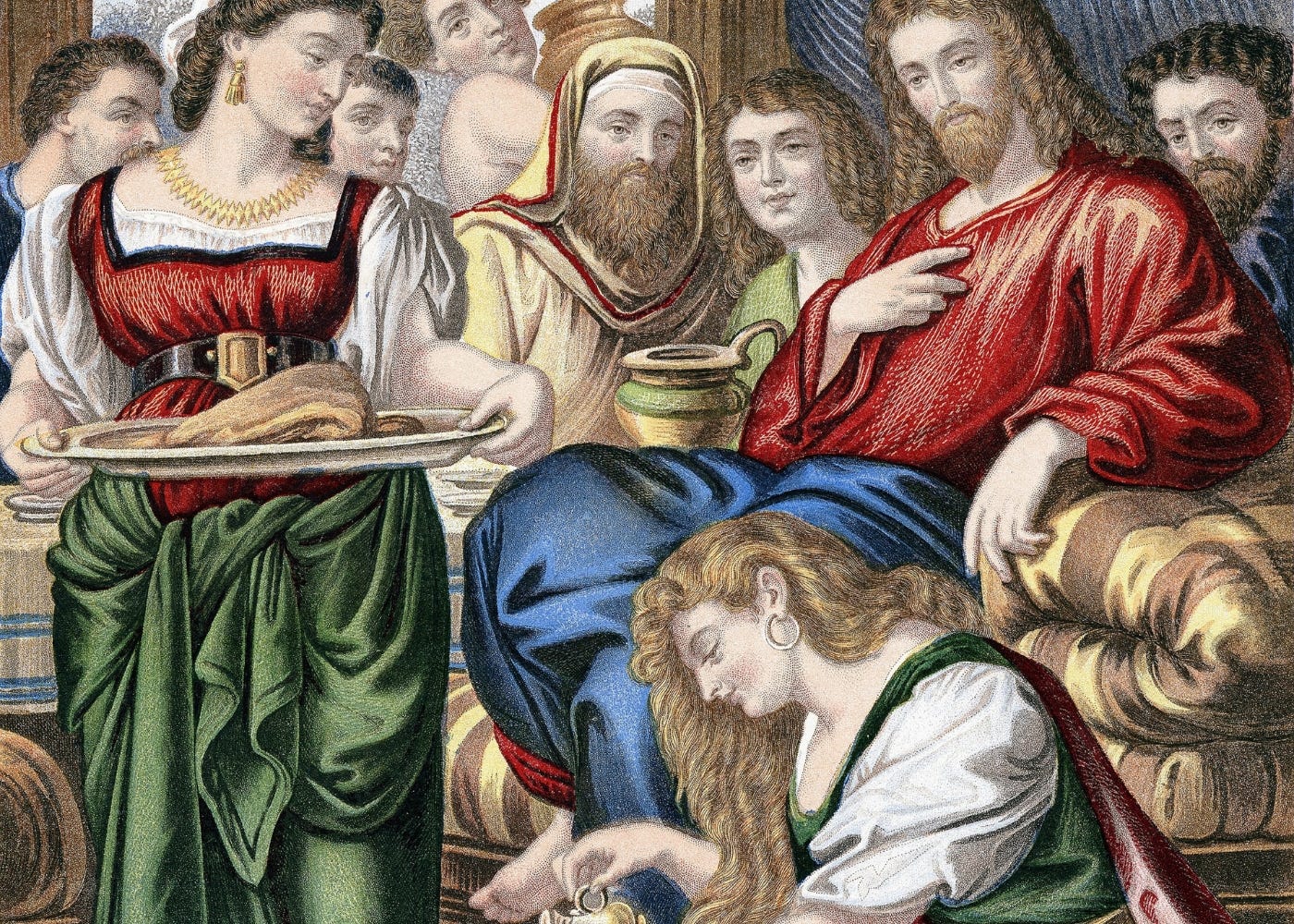
Latter-day Saints are often told that the contemporary Church is built on the same model Jesus Christ used to establish His church. In this bonus re-release, Cynthia and Susan offer a few thoughts on that idea, and also discuss the pattern they see: the Bible doesn’t only show Jesus choosing women in the New Testament—beginning with Eve, women are cast in pivotal roles from the very start.
The original episode explores how Jesus’s inclusion of women was radical within its cultural context. Yet for most of history, his namesake religion has been marked by near-total domination of the patriarchy. What happened? Greg Prince once asked Chieko Okazaki a question that bears repeating: “…where do we need to go to get women in the Church where He wants them to be?” In Episode 248, Cynthia and Susan pose that question again, shining light on a few of the women hidden in plain sight at Christianity’s beginnings.
Notes & Quotes:
ALSSI Ep. 97, Christ Chose Women
Pres. Gordon B. Hinckley on Larry King Live, 09/08/1998
The Girl Who Baptized Herself: How a Lost Scripture About a Saint Named Thecla Reveals the Power of Knowing Our Worth, by Meggan Watterson
Purity and Parallels: Constructing the Apostasy Narrative of Early Christianity, by Taylor G. Petrey
A Beautiful Year: 52 Meditations on Faith, Wisdom, and Perseverance, by Diana Butler Bass
NPC Headliner Luncheon: Elder David A. Bednar, The Church of Jesus Christ of Latter-day Saints, 05/26/2022
Apostle David Bednar quizzed on declining LDS growth, same-sex marriage, ‘Under the Banner,’ Salt Lake Tribune, by Peggy Fletcher Stack, 05/26/2022
Taylor Petrey on Facebook, 05/27/2022
The LDS Temple Ceremony: Historical Origins and Religious Value, Dialogue Journal, by Edward H. Ashment, 10/01/1994
Christianity is Many Things, Learning to See with Brian McLaren, podcast Season 3 Ep. 1, 05/21/2022
There Is Always a Struggle: An Interview with Chieko N. Okazaki, Dialogue Journal, by Greg Prince, 11/25/2005
Elder Joanna?, By Common Consent: A Mormon Blog, by Kevin Barney, 06/16/2007
Mary Magdalene Revealed: The First Apostle, Her Feminist Gospel, and the Christianity We Haven’t Tried Yet, by Meggan Watterson
The Gospel of Mary Magdalene, Breaking Down Patriarchy, by Amy Allebest, podcast Season 1 Ep. 15, 11/25/2021
Who Was Junia? The Junia Project
Junia The Apostle and Mormonism’s Priesthood, Patheos, by Taylor Petrie, 10/05/2014
Shifting Footings, by Scot McKnight, Patheos, 01/02/2012
3 reasons Mormons don’t know what to do with the Apostle Paul, Religion News Service, by Jana Riess (Flunking Sainthood), 08/02/2019
The Acts of Thecla: A Pauline Tradition Linked to Women, by Nancy A. Carter, January 2000
Rebecca Solnit on Facebook, 06/02/2022
“In another usage of the term apostle, Paul offers greetings to Andronicus and a woman named Junia, who are “outstanding among the apostles” (Rom 16:7). These otherwise unknown apostles reveal key information about this group. First, this reference confirms that for Paul the term apostle is not restricted to the twelve but, rather, constitutes those in an informal network of missionary workers. Second, Paul calls a woman an apostle, suggesting that the male-only tradition of apostleship has not yet been established for the communities in which Paul works. A majority of those greeted as coworkers, apostles, and deacons in Romans 16 are women. In no instance does Paul discuss an apostle with a priesthood or an institutional office. Other texts around the turn of the second century … are unaware of a restriction to twelve apostles or their distinctive authority, let alone that they were all dead by the time those texts would have been written. Rather, in these texts the apostles are itinerant teachers and miracle workers, not members of a hierarchy of formal leadership.” —Taylor Petrey
“Power can be defined as the ability to make a particular perspective seem universal.” —Alok Vaid-Menon
“Mary is Mary because of Jesus. But Jesus was born Jesus because of Mary, who responded to the call of God, as did Isaiah of old: Here am I, the servant of the Lord. Without her, the light would not have shined forth amid the oppression and injustice.” —Diana Butler Bass
“Mary Magdalene confessed Jesus as Messiah, served him dinner, anointed him for kingship and burial, witnessed his execution, and proclaimed news of his resurrection. These are the things she did. We’ve forgotten. The memory of her was obscured.
“Lazarus was resurrected centuries ago. Maybe this is the time when his sister—Mary Magdalene—is finally resurrected. It is well past time to remember.” —Diana Butler Bass
“We follow the pattern of the ancient church. … The pattern anciently was that the apostles were men.” —Elder David A. Bednar
“Jesus has not stayed the same for me through my whole life’s journey. And so I’ve had to be open to understanding that even though there’s one verse in Hebrews that says Jesus Christ the same yesterday, today, and forever, I have not stayed the same yesterday, today, and forever. The church does not stay the same yesterday, today, and forever.
And so in a very real way, Jesus has changed for me. Jesus changes for the world. Jesus changes for the institutions of faith, for the church.” —Diana Butler Bass
“It seems to me like Christ loved the women. I think he really included them in many areas where Jewish society excluded them. He didn’t mind breaking those rules.” —Chieko Okazaki
“…It is difficult for us to appreciate how radical Jesus was to include women in his entourage. Women simply didn’t travel with men to whom they were not related….Jesus ignored the ritual impurity of a woman’s menstruation, which normally would have been an impediment to this kind of frequent contact.” —Kevin Barney
“According to the canonical gospels, Mary Magdalene was present at the crucifixion, she was there at the burial, and she was there alone at the empty tomb. And she is the first to witness the resurrection. Let me say that again: MM was the one Christ resurrected to. In the Gospel of John, Christ gives MM special instructions and commissions her to be the one to announce the good news. Her. She is the one he chooses.” —Meggan Watterson (MM Revealed, p. 108)
“If Christian theologians in the Latin West were going to establish an exclusively male church, then the central figure to Christ’s story, Mary Magdalene, needed to be retold. Starting in the 4th century, with the formation of the traditional bible, all of the gospels that confirmed Mary’s spiritual authority and unique relationship with Christ were excluded from the canon and deemed ‘heretical,’ like the Gospel of Mary Magdalene, the Gospel of Philip, and the Gospel of Thomas. And the scriptures that confirmed and validated women’s leadership in the earliest forms of Christianity like The Acts of Paul and Thecla, were also excluded.” —Meggan Watterson (MM Revealed, p. 106)
“To be sure, the word ‘apostle’ undoubtedly has a narrow meaning (the twelve, Paul, etc.) and it has a broader meaning (church-planting, founding, missionary). It still means ‘apostle’ (one sent by Christ) and not only that — this term describes the highest office for the first century Christians. And Junia is in that small and highly esteemed circle.” —Scot McKnight
“If we hadn’t silenced women and asked them to leave the altar from the start, I wonder what the world would be like now. And I wonder how girls and women would be treated if we would have been able, all along, to hear who Christ was, who Christ is according to women, to mothers, to daughters … Or to put it another way, I am excited to see how the world might change once we do.” —Meggan Watterson (MM Revealed, p. 47)
I finally finished listening to this episode today and then read this (https://open.substack.com/pub/jaymallow/p/authoritarianism-and-truth-d7d?utm_source=share&utm_medium=android&r=3jwh5)
tonight. The whole way through, it had me thinking about how you guys were talking about AoF 6 vs AoF 9. No flexibility bc be what was before vs adaptation through continuing revelation.
He's writing from a different religious viewpoint, but we've never minded that before, and I'm 🤞 you'll recognize the same parallels I did.