



A Wrinkle In Time and How NOT to Build Zion
by Mara
“And the Lord called his people ZION, because they were of one heart and one mind, and dwelt in righteousness; and there was no poor among them.” (Moses 7:18)
In this essay I will address the building of Zion, how we may
be thinking about it in a flawed way, and how we can think about it instead. I will focus on the qualification “of one heart and one mind”—the principle of unity.
The scripture I just quoted in Moses is a description of the city of Enoch, and it could be argued that the description is unique to just that city. It is commonly used as a description in the church, however, as the kind of society we should be working for, since prophecies claim that Zion, the New Jerusalem, will be built in the last days, and we are also members of Zion inasmuch as we are members of stakes of The Church of Jesus Christ of Latter-day Saints. In addition, the scripture says the people were called Zion “because they were of one heart and one mind,” implying that Zion is a title bestowed on people who meet those qualifications and not just the people of Enoch. I feel it is therefore appropriate here to discuss the building of Zion as something that we can all work towards.
At this point you might be wondering about why I called this piece “How NOT to build Zion.” In addition to being an attention-grabber, this title shows that most of this essay will focus on how this scripture can be misinterpreted and how we can read it instead.
The idea of being “of one heart and one mind” can be interpreted in more than one way, and I would like to discuss one way this could be interpreted that I am going to argue is incorrect—that everyone feels, thinks, and acts exactly the same.
This is not a completely unreasonable way to understand the scripture, since other scriptures tell us,
“I say unto you, be one; and if ye are not one, ye are not mine.” (D&C 38:27)
and
“I beseech you that there be no divisions among you, but that ye be perfectly joined together.” (1 Corinthians 1:10)
However, if the idea of “one heart and one mind” is applied irresponsibly, it may be interpreted to mean that we give up our agency and individuality and all become exactly the same. I argue that sameness is undesirable as a quality in Zion, while unity can be built another way.
In the well-known book “A Wrinkle in Time” by Madeleine L’Engle, the characters Meg and Charles Wallace visit a planet called Camazotz where everyone behaves exactly the same because they are controlled by a totalitarian mind called IT that does not tolerate any deviation. When they first enter the town, they view a residential neighborhood that seems to be like a pleasant place at first but they soon discover there is a difference from what they are used to.
“In front of all the houses children were playing. Some were skipping rope, some were bouncing balls. Meg felt vaguely that something was wrong with their play… “’Look!’ Charles Wallace said suddenly. ‘They’re skipping and bouncing in rhythm! Everyone’s doing it at exactly the same moment.’… “Then the doors of the houses opened simultaneously and out came women like a row of paper dolls… Each woman stood on the steps of her house. Each clapped. Each child with the ball caught the ball. Each child with the skipping rope folded the rope. Each child turned and walked into the house. The doors clicked shut behind them. “’How can they do it?’ Meg asked wonderingly. ‘We couldn’t do it that way if we tried. What does it mean?’”
Meg and Charles Wallace continue into town and discover that these children and mothers, along with other inhabitants of the town, are under the strict control of the being IT, which uses fear and intimidation to make everything perfect. The effect is absolutely chilling: everything on the planet works perfectly because IT wills it so. IT tells the children:
“’...I thought it would perhaps save you pain if I showed you at once that it would do you no good to try to oppose me. You see, what you will soon realize is that there is no need to fight me. Not only is there no need, but you will not have the slightest desire to do so. For why should you wish to fight someone who is only here to save you pain and trouble? For you, as well as for the rest of the happy, useful people on this planet, I, in my own strength, am willing to assume all the pain, all the responsibility, all the burdens of thought and decision...And our decisions will be one, yours and mine. Don’t you see how much better, how much easier for you that is?” (emphasis in original)
The effect is quite chilling. IT’s words remind me of the arguments made by Lucifer during the council in heaven:
“Behold, here am I, send me, I will be they son, and I will redeem all mankind, that one soul shall not be lost, and surely I will do it; wherefore give me thine honor.” (Moses 4: 1)
We might often feel that the Church is teaching that everyone must be exactly the same; we certainly do have a lot of commandments and “rules” that we expect people to follow in order to be considered a “good” member. But in fact the scriptures have taught us that it is only in diversity, not sameness, that we will be able to build things properly.
Consider the teachings in 1 Corinthians 12, which compares the followers of Christ to a human body:
“If the whole body were an eye, where were the hearing? If the whole were hearing, where were the smelling? But now hath God set the members every one of them in the body, as it hath pleased him. And if they were all one member, where were the body? But now they are many members, yet one body. And the eye cannot say to the hand, I have no need of thee: nor again the head to the feet, I have no need of you.” (1 Corinthians 12: 17-21)
The author explains clearly here why sameness is not only not unifying but also not useful. “And if they were one member, where were the body?” In other words, if all the people of Christ were hands, exactly as the same as each other, we would not have a unified body, but only a collection of disembodied hands. And since each of the hands was exactly the same, the body would receive no additional functionality by joining two or more of the hands together. So they are separated and each hand has only the functionality it brought to the situation.
When the people of Christ are different types of body parts, however, the body is able to be unified: “But now hath God set the members every one of them in the body.” The parts make a body together and complement each other as members of the body. In addition, each part in this diverse body has access to the utility of the other parts of the body: the eye cannot hear, and the ear cannot smell. But by being part of a great body with the other members, each body part has access to the functionality of the whole body and contributes to that greater functionality.
Discussions of spiritual gifts in the scriptures also point out that diversity is needed for increased functionality as a unified church:
“And again, I exhort you, my brethren, that ye deny not the gifts of God… And there are different ways that these gifts are administered; but it is the same God who worketh all in all; and they are given by the manifestations of the Spirit of God unto men, to profit them.” (Moroni 10: 8)
They are given by the Spirit to profit them as a whole, not just one particular member. Therefore, the collective, unified body has access to all of the spiritual gifts, increasing its abilities in comparison to one member.
In short, Zion is not Zion in spite of diversity, but because of diversity. Those members of the church who feel they are different are just what the church needs, and the church as a whole suffers when they choose not to be part of us.
What does it mean then to be “of one heart and one mind?” How can we then understand these scriptures without understanding them to be talking about complete sameness? Consider these descriptions of the kind of mind and heart we should have:
“...Thou shalt love the Lord thy God with all they heart, and with all thy soul, and with all thy mind.” (Matthew 22:37)
“...that ye stand fast in one spirit, with one mind striving together for the faith of the gospel;” (Phillipians 1:27)
“For this is the covenant that I will make with the house of Israel after those days, saith the Lord; I will put my laws into their mind, and write them in their hearts: and I will be to them a God, and they shall be to me a people:” (Hebrews 8:10)
“And ye will not have a mind to injure one another, but to live peaceably…” (Mosiah 4:13)
“Behold, the Lord requireth the heart and a willing mind;” (D&C 64:34)
“Blessed are the pure in heart…” (Matthew 5:8)
“And ye shall offer for a sacrifice… a broken heart and a contrite spirit…” (3 Nephi 9:20)
We can bring minds that are full of love, striving, peaceful, and willing to make covenants with the Lord, and hearts that are loving, contrite and pure. These are the characteristics that will unify us in a way that we are not all the same like servants of a controlling IT-like mind, but that we can benefit from each other’s differences.


Checking Boxes
by Marlee Bedke

Letting the Fields Lie Fallow
by Brooke RaNae Palmer
I live in Southeastern Idaho, just over the Utah border in
the first Idaho community settled by Mormon pioneers. When they arrived, the land was thick with sagebrush—wild, dry, and unpromising. What transformed it into farmland was not just effort, but an irrigation system.
To catch the spring snowmelt, they excavated reservoirs with horse teams and cast iron implements, carved canals and ditches with hand tools, and relied on gravity to carry water across hundreds of acres. It was a carefully planned feat of engineering.
Presently there are 5 canal companies and 13 reservoirs in Franklin County, and many of the ditches and canals have been encased in pipe and buried in the ground, and by-and-large, it is still gravity that sends the water where it needs to go. For more than a century, water has moved because it has been guided to move, again and again, in a carefully maintained system.
This irrigation infrastructure has shaped the land, and it shaped the people who lived on it—teaching them to produce, to maximize, to make the desert yield. Over time, farming became the dominant industry here, and with it came a rhythm: plow, sew, water, grow, harvest, repeat.
Despite improving the rate of crop production, on-demand irrigation isn’t always positive. Constant farming also depletes the ground of minerals and nutrients, which then are usually replaced with another man-made innovation: chemical fertilizers. (But that’s a subject for another day.)
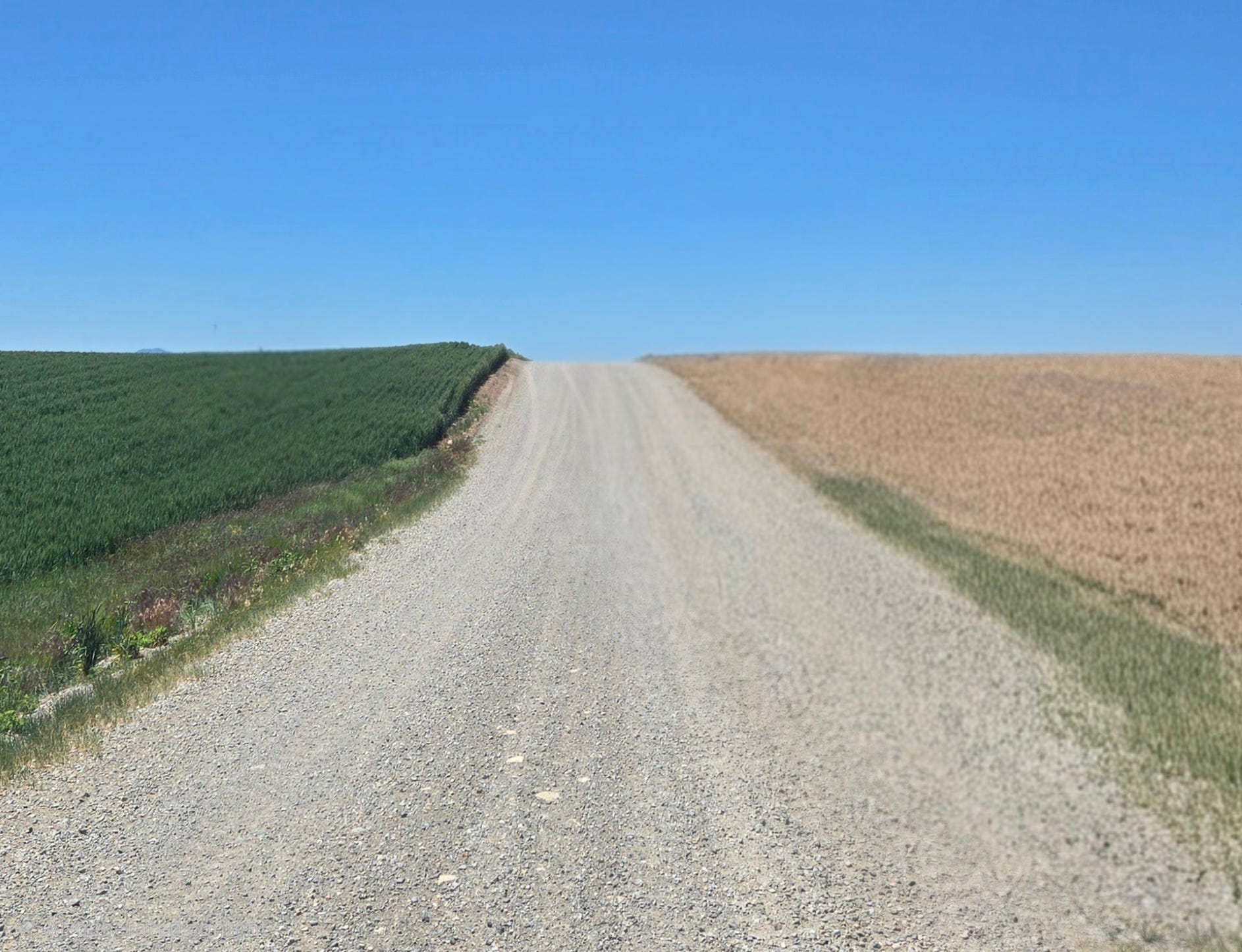
As you travel north, there are “dry farm,” areas where irrigation is not able to reach. The land is too far from the reservoirs, or it is too hilly for the gravity flow to be able to work. So, these farmers have learned to farm in a different way. Some years these fields lie fallow. To a passerby, they look abandoned: overgrown with weeds, marked by washouts where snowmelt has pooled and receded. They do not appear productive. They do not appear tended.
And yet, this too is a deliberate practice because through this period of rest, the soil is able to gather moisture deep into the ground. The weeds, when eventually turned under, become nourishment. When the field is planted again—often with hardy wheat—it draws on what has been quietly stored below the surface. The crop is able to grow without being dependent on a man-made watering system. It can even grow through a summer that gets very little rain because the moisture has been allowed to accumulate in the earth. It may yield less than irrigated land, but it yields enough. It survives.
I can guarantee that over the past 165 years, these stewards of the land have tried to come up with a way to get onto an irrigated system. It’s not for lack of ingenuity, or money, or will power. It would take a seismic shift in the landscape for something like that to happen.
On the other hand, there are thousands of acres watered by man-made irrigation, and so they’re able to produce more varied and abundant crops. They are not as limited by the amount of water that is provided by rainfall. On irrigated land, a farmer can sometimes get up to four cuttings of hay, compared to two on a dry farm.
Growing up in the church, in a community that was predominately LDS, I was part of a man-made irrigated system. I was watered consistently and thoroughly. As a child I grew both homemaking and leadership skills. As a young woman I produced a temple marriage and raised 4 wonderful children. As a member of my ward, I was a steward of Primary children, YW and YM, and Relief Society sisters. And like the irrigated fields around me, I was taught—implicitly and explicitly—to produce, produce, produce.
But then the unthinkable happened, I experienced a huge seismic shift, one that had been building up for years. There had been tremors, but I ignored them in favor of producing. This shift threw me off of the irrigation system that had been the framework of my life.
All of a sudden, the pipes that led out of my reservoir were fractured, the flow disrupted, and I learned that systems, even sustaining ones, can break if they become too rigid and confining.
I tried to limp along, doing the same things I’d always done, tried to grow the same crops, followed the same patterns, expected the same results, but without the constant water, my output shriveled up. I found myself exhausted, unable to sustain what once felt natural. I tried to get back on the system, but returning to the old system was not an option; it no longer felt like nourishment. It felt contaminated.
What I did not realize, at first, was that I was being invited into a different method of growing—the kind practiced by dry farmers, a season of fallowness, completely reliant on mother nature.
Having observed many fallow fields over the years, I knew during this phase of fallow-ness the field would be ugly. There would be weeds growing in it. There would be washouts from melt-off and rain. My neighbors might drive by and wonder what happened to my beautifully cultivated field and why I was letting it run to ruin now.
I am learning how to let a field lie fallow. I know my field doesn’t have to look perfect, or even pretty.
However, I don’t have to rely solely on my own observations as I employ this technique. This, too, has roots in my inheritance, I have dry farming in my genetic code. Not only do I have Mormon pioneers on one side of the family, but I also come from Volga German stock. In 1762 Catherine the Great invited immigrants to settle in Russia. Many Hessian Germans formed a community on the banks of the Volga River and there they developed agricultural practices shaped by scarcity and resilience: crop rotation, soil stewardship, and the intentional leaving of land unplanted. They became some of the most important wheat growers in the empire.
However, their history, too, is marked by disruption. By the late 19th century there had been many seismic shifts in Russian politics and eventually many of the Volga Germans emigrated to the United States. Carrying their knowledge with them to the mid-west and western states, they grew a variety of crops: rye, potatoes, sunflowers, sugar beets and the red wheat with which we are all familiar. Adaptation was not optional; it was survival. Long before any Mormon Utahans were farming, the Volga Germans had been using innovative farming techniques, including allowing a field to lay fallow. They understood that in order to get the best production out a piece of ground, they needed to let it rest, to gather moisture and nutrients.
If the Mormon pioneers taught me how to build systems, the Volga Germans remind me how to live when those systems fail. If you Google “Volga Germans” you will see that they are known for their tenacious work ethic. If you read between the lines, you will also notice that they are farmers who understood the necessity of rest and were remarkably versatile. And while I applaud my Mormon ancestors for their tenacity and work ethic, I feel like those of us in the Mormon belt may have lost the versatility that we once had. Instead, we are relying too much on man-made irrigation to produce, produce, produce.
Now after this seismic shift in my own life, I am going to hearken back to my German roots, where a season of fallowness isn’t a liability, it isn’t unacceptable, but is counted as necessary. I am learning how to let a field lie fallow. I know my field doesn’t have to look perfect, or even pretty. It’s okay that it’s filled with weeds—unanswered questions, unfinished thoughts, grief that surfaces unpredictably. There are washouts, places where old structures have collapsed under the weight of change. From the outside, it might appear neglected, as though I have stepped away from responsibility or purpose. To be fallow is to remain present without forcing growth. It is to trust that something is happening beneath the surface, even when it cannot be measured or displayed.
This season is sustaining me in ways I could not have anticipated. It has loosened my dependence on constant production. It has reconnected me to something more elemental—something like the slow accumulation of moisture in the soil, unseen but essential. At some point, in a season when I’m strong enough, or feel good enough, or when I’ve finally figure something out, I’ll just plow everything under and those weeds will be part of the nourishment of the soil. I do not know yet what I will plant when this season ends. I suspect it will be something different from what I grew before—something that can reach deeper, something less dependent on carefully controlled systems, one that isn’t common in this LDS soil. A crop that doesn’t leave me burned-out or reliant on anything man-made.
For now, it is enough to tend this field as it is. To let the field lie fallow. To trust the work of rest. To believe that meaning, like water, does not always arrive on command—but can still be gathered, held, and, in time, made to nourish what comes next.


Women Who Understand
by Lisa Fluckiger


A Vision of Living Thread
by Jessie Santa Maria Whittaker
And it came to pass that I beheld a land covered in mist, and many
voices were heard within it, speaking commandments and judgments to the travelers who walked there.
And the mist was thick at times, heavy with the weight of words and expectations, pressing upon the shoulders of those who passed. And at other times it parted, letting light spill gently upon the path of the traveler.
And I saw a rod of iron stretching across the land, straight and unbending, and many did cling unto it with great effort. And the rod did ascend upward unto a great building that stood high above the earth.
And the building was filled with people who looked down from lofty windows and balconies. They spoke with certainty and mocked the travelers in the mist. And though the building appeared magnificent, I perceived that it had no foundation beneath it.
And near the rod I beheld a young girl who had just loosed her hands from the iron. She looked upon the building with troubled eyes, for she knew it was not her home, yet she feared to depart from the path she had been taught.
And as I watched, a thread of gold came gently into my hands. It was soft and living, and it moved with me as I walked.
And I perceived that the thread grew brighter when I walked in compassion, and dimmed when I walked in fear, yet it did not depart from me.
And I beheld that there were many such threads moving through the mist in every direction. Some crossed and some parted, yet all were woven together into a great tapestry that stretched across the earth.
And I saw that the tapestry was not yet complete, for new threads were continually being woven into it by the lives of those who walked the earth.
And following the thread, I came unto a tree whose beauty was beyond all that I had known. And the fruit thereof filled my soul with a great and quiet love, sweet and comforting to taste.
And I beheld that the roots of the tree reached deep into the earth and drew life from hidden waters beneath the world, even from living springs that did not fail.
And the branches spread wide as though to gather all who hungered for its fruit.
And I saw that the trunk of the tree opened as a doorway, and beyond it was a garden where light and shadow dwelt together, and the light made the shadows gentle.
And I turned again and saw the young girl standing in the mist, and I went unto her and held her with compassion, for I knew her burdens and her longing for goodness.
And as we stood beneath the tree, I perceived that the light which shone there had also been within us from the beginning, a spark of the divine entrusted to our care.
And the golden threads continued to move through the world, weaving the journeys of many souls together.
And I knew then that the journey toward God was not a single road to be followed, but a living weaving of souls learning, stumbling, and shining together.
And I bore record that the love which grew from that tree was the true guide of the soul; and whosoever walked in that love need not fear the mist, for the light within them would ever lead them onward.

Contributors:
Mara

Marlee Bedke
Marlee is a “stretchy saint” that’s doing her best to find her place and voice at church. She’s become the girl that shocks her southern Utah ward by holding her daughter during her baby blessing, wearing a rainbow bracelet, finding God outside the normal Primary answers, and sharing “liberal” things on social media. She’s lucky to be married to her best friend, and they lead their home and 2 young kids as equal partners. She’s a mindful yoga teacher, a daycare supervisor, an amateur gardener, a proud firefighter wife, a sourdough baker, a hiker, a Krispy Kreme fanatic and an avid reader.
Brooke RaNae Palmer
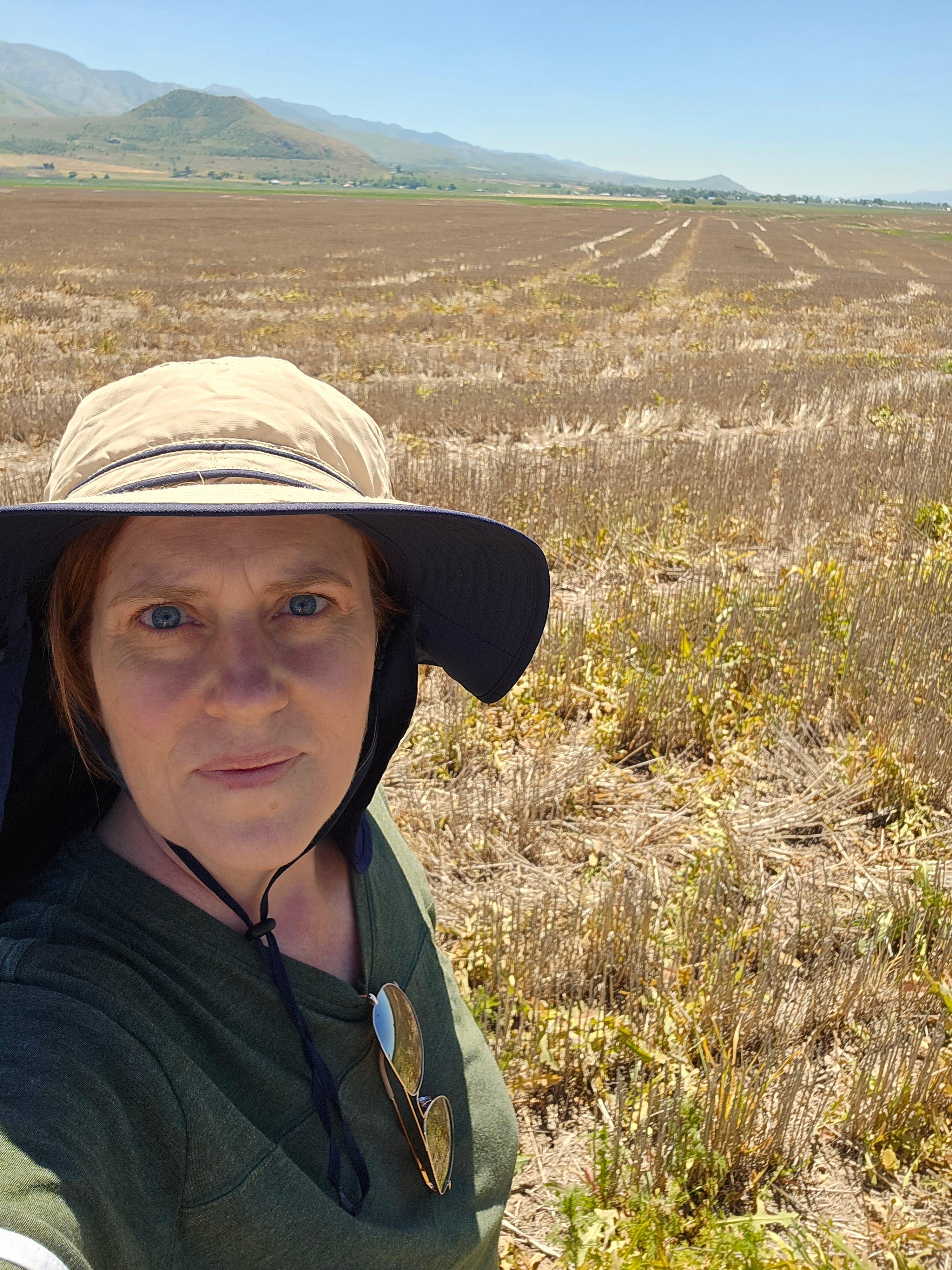
Brooke is a big thinker, voracious reader, stained glass enthusiast, and heavy metal headbanger, in addition to being a loving nana, mother of 4, happy farm wife and badass homemaker.
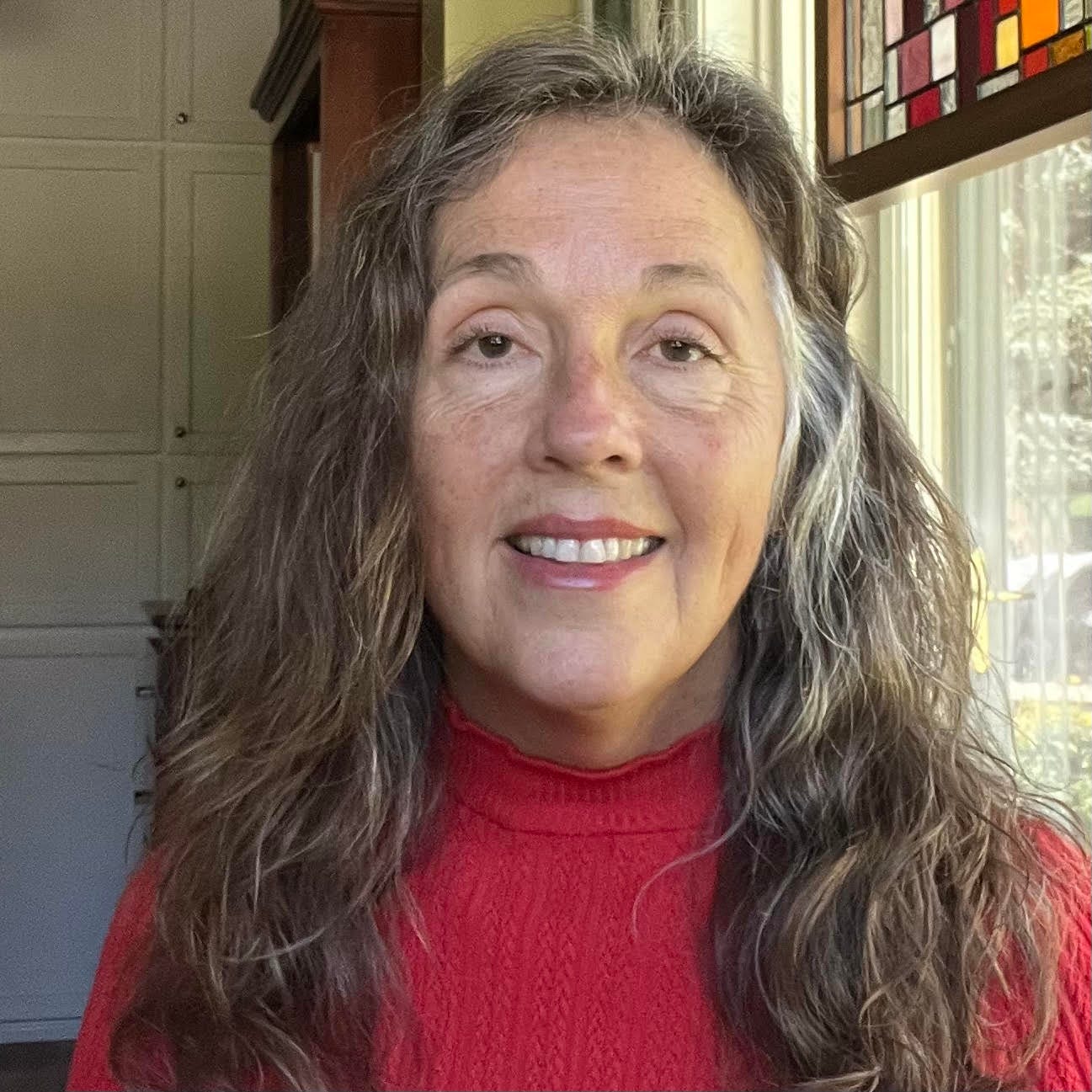
Lisa Fluckiger
Lisa is a second year grad student in Chadron State College's Clinical Mental Health Counseling MAE program. Her most recent work has been providing SEL education and support for middle school students. Long ago at BYU, Lisa earned a BA degree in chemistry and then a master's degree in Curriculum and Instruction, with an emphasis in the inclusive classroom. Her family owns a small artisan bakery in the small town where they live, and it is a place where their daughter, Eleanor, can have meaningful work and continue to participate in the community. Totally her husband's dream, and she is all for it! In addition to studying mental health, Lisa is loving life beyond church, running with her dogs, yoga, and writing. Also Netflix.
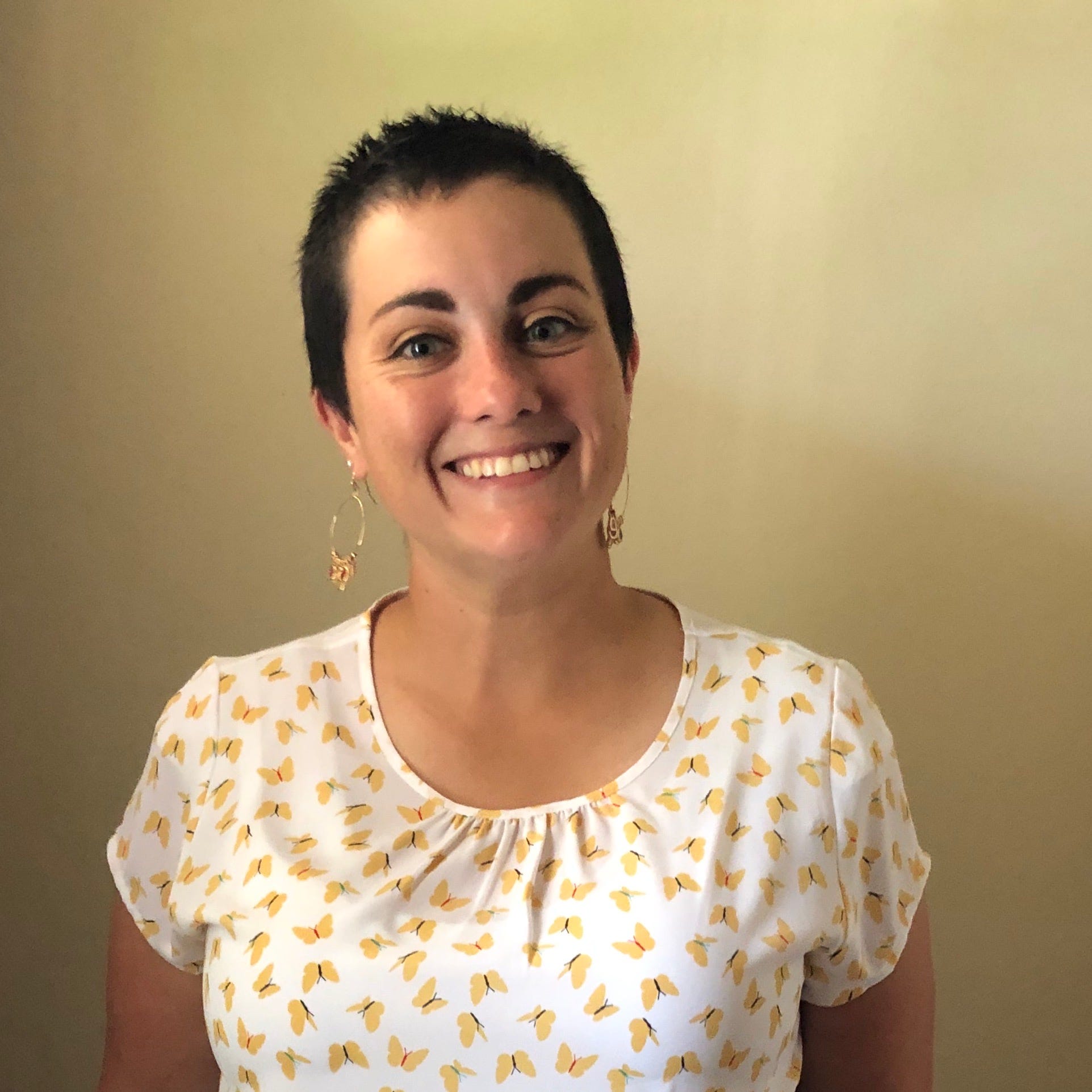
Jessie Santa Maria Whittaker
Therapist, writer, professional meaning-maker, wife, and momma. Jessie sits with big feelings, sacred questions, and nervous systems that have had a rough day—or life. She is a lover of Christmas magic, messy faith, honest stories, and the brave work of becoming fully human.
Thanks for supporting ALSSI! Have something to say? Join the conversation! Send us a voicemail, start a chat thread … or write a piece for a future Say More.